When Bad Science Enters the Interview Room — and Eventually the Courtroom
by Stan B. Walters
ORCID: 0009-0002-1063-0519
DOI: 10.5281/zenodo.21430135
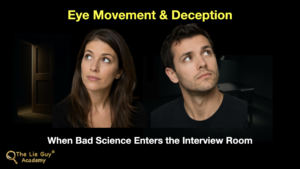
There are few deception myths that have traveled farther, lasted longer, or been repeated with more confidence than the claim that eye movement reveals whether a person is lying. Many investigators have heard some version of it. If a person looks one direction, they are remembering. If they look another direction, they are creating or fabricating. If their eyes move differently from their “normal” pattern, then supposedly deception is present.
It sounds practical. It sounds easy to teach. It is visually memorable, which makes it even more attractive in the classroom. The problem is that sounding practical and being scientifically reliable are not the same thing. In the interview room, that difference matters.
The Problem With a Simple Shortcut
Eye movement may tell us that a person is thinking. It may tell us that a person is searching memory, processing a question, feeling pressure, becoming distracted, or simply shifting their gaze. What it does not reliably tell us is whether the person is telling the truth or lying.
That is where the danger begins. A normal human behavior gets converted into a diagnostic shortcut. The shortcut gets repeated in a classroom. The classroom repetition gives it the appearance of authority. Before long, an investigator may begin to treat eye direction as evidence of deception rather than as a behavior that needs context, caution, and corroboration.
The claim is especially dangerous because it gives the interviewer the illusion of precision. It suggests that deception can be identified in a glance, as if the subject’s eyes are providing a directional map to truth or fabrication. That may be useful for a dramatic television scene, but it is not a reliable foundation for investigative decision-making.
The Research Problem
The eye-movement claim is often associated with Neuro-Linguistic Programming, or NLP, and the idea that different eye directions reveal different cognitive processes. One of the more common versions claims that looking up to one side reflects memory, while looking up to the other side reflects construction or fabrication. From there, the claim is extended into the interview room as a supposed deception cue.
The problem is that research has not supported that claim as a reliable method of lie detection. In a 2012 study published in PLOS ONE, researchers tested the NLP-based claim that certain eye movements indicate lying. Their studies found that the eye movement patterns of people who were lying or telling the truth did not match the claimed NLP pattern. They also found no support for the idea that eye direction could be used in the way many people had been taught to use it.
That should matter to every academy director, investigator, instructor, and agency attorney. If a method is going to be taught as a reliable indicator of deception, it needs more than repetition, tradition, and classroom confidence behind it. It needs evidence.
The Daubert Problem
This is where the Daubert issue becomes important. In Daubert v. Merrell Dow Pharmaceuticals, the United States Supreme Court addressed the admissibility of scientific expert testimony and placed the trial judge in the role of gatekeeper. The question is not simply whether an expert sounds confident or whether a technique has been used for a long time. The question is whether the method is reliable enough to assist the court.
The Daubert factors commonly include whether the theory or technique can be and has been tested, whether it has been subjected to peer review and publication, whether it has a known or potential error rate, whether there are standards controlling its use, and whether it is generally accepted in the relevant scientific community.
Those are not unreasonable questions. They are the kinds of questions we should already be asking before a claim ever makes its way into an academy classroom or an interview and interrogation course. Can this claim be tested? Has it been peer reviewed? What is the known error rate? Is there a reliable standard for applying it? Is it generally accepted by the scientific community most qualified to evaluate it?
When the claim is that eye direction reveals deception, those questions become very uncomfortable very quickly.
From Classroom Claim to Interview Contamination
Some may argue that teaching eye movement as a deception cue is harmless as long as it is presented as only one possible indicator. I disagree. Unsupported cues are rarely harmless once they enter the interview room. They influence what the interviewer notices, what the interviewer ignores, and what the interviewer believes is happening.
If an investigator has been taught that a particular eye movement suggests deception, then that movement can become a trigger for suspicion. Suspicion can change the tone of the interview. It can change the questions asked, the amount of evidence revealed, and the way the subject’s answers are interpreted. That is how a weak cue can become the first step in a much larger reliability problem.
The real issue is not the subject’s eye movement. The real issue is the interviewer’s diagnostic system. When the diagnostic system is built on folklore, the interview is already moving in the wrong direction.
How a Bad Cue Becomes Confirmation Bias
The danger is not that an eye movement causes a false confession. The danger is that an interviewer who has been taught to treat eye movement as deception may form a premature belief that the subject is lying. Once that belief forms, confirmation bias can begin shaping what the interviewer notices, ignores, asks, discloses, and interprets.
That is why unsupported deception cues are not just a training-room problem. They are an investigative reliability problem. A weak cue can become the seed of a strong conclusion. Once the interviewer believes deception has been detected, every later answer may be filtered through that belief. The interviewer may begin to hear resistance where there is confusion, evasiveness where there is uncertainty, or guilt where there is only stress.
This is how tunnel vision can begin. Not always from bad intent. Not always from misconduct. Sometimes it begins with a bad assumption that was taught with confidence, repeated without testing, and accepted because it sounded useful.
In many DNA-confirmed wrongful conviction and false confession cases, the confession did not stand alone. It was surrounded by a pattern of tunnel vision, confirmation bias, contamination, and post-confession reinforcement. That does not mean eye-movement myths create false confessions by themselves. It means unreliable diagnostic shortcuts can help push an interviewer into the very mindset that makes false confessions, contaminated statements, and investigative errors more likely.
That is the part agencies should pay attention to. If an unsupported cue helps form the interviewer’s initial belief, then the agency may later have to explain why that cue was taught, who taught it, and whether it had any reliable scientific foundation.
What Should Be Taught Instead?
Investigators should not be trained to hunt for isolated body language shortcuts. They should be trained to evaluate information quality, statement reliability, consistency, context, sensory detail, cognitive detail, and corroboration. The goal is not to “spot the liar.” The goal is to determine whether the information being provided is reliable, testable, and supported by evidence.
Eye movement may be observed, but it should not be elevated into a conclusion. A person looking away, looking up, looking down, or shifting gaze may mean many things. Without context, it means very little. Without research support, it should not be taught as a reliable deception indicator. Without corroboration, it should not influence the direction of an investigation.
That is the difference between behavior theater and behavior analysis. Behavior theater gives investigators memorable claims that sound useful in the classroom. Behavior analysis requires discipline, context, testing, and restraint.
Audit the Curriculum Before the Courtroom Does
The eye movement myth is not just a harmless classroom shortcut. It is a reminder that unsupported claims can sound practical, memorable, and convincing — right up until they influence an interview, shape a report, or enter a courtroom.
Agencies should not wait for a deposition, suppression hearing, civil claim, or expert challenge to discover that unsupported deception cues have been sitting inside their training materials for years. If a method cannot survive scientific review, it should not be taught as a reliable investigative tool. And if it cannot survive Daubert, it certainly should not be allowed to travel from the classroom into the interview room, from the interview room into the report, and from the report into the courtroom.
Perhaps it is time to audit what is being taught in the training room, because if this claim slipped into interview training, what else may be following investigators into the interview room — and eventually the courtroom?
And who brought it in?
Selected Research
Wiseman, R., Watt, C., ten Brinke, L., Porter, S., Couper, S. L., & Rankin, C. (2012). The Eyes Don’t Have It: Lie Detection and Neuro-Linguistic Programming. PLOS ONE, 7(7), e40259. https://doi.org/10.1371/journal.pone.0040259
Mann, S., Vrij, A., Nasholm, E., Warmelink, L., Leal, S., & Forrester, D. (2012). The Direction of Deception: Neuro-Linguistic Programming as a Lie Detection Tool. Journal of Police and Criminal Psychology, 27, 160–166. https://doi.org/10.1007/s11896-011-9097-8
DePaulo, B. M., Lindsay, J. J., Malone, B. E., Muhlenbruck, L., Charlton, K., & Cooper, H. (2003). Cues to Deception. Psychological Bulletin, 129(1), 74–118. https://doi.org/10.1037/0033-2909.129.1.74
© 2026 Stan B. Walters. All rights reserved. Brief excerpts may be quoted with attribution and a link to the original article. Reproduction, redistribution, or use in training materials requires written permission.