
Among the most important photographs that should be taken at an officer involved shooting investigation are photographs that depict visual perspectives. The visual perspective of every individual involved in or witnessing the event should be photographically documented.
For example:
- The visual perspective representing the officer’s view looking toward the subject.
- The visual perspective of the subject looking back toward the officer.
- For any eyewitnesses who give accounts to the event – the perspective of each witness should be photo documented from the position where the witness is standing, looking in the direction that he or she claims to have been looking.
When taking perspective photographs, consider noting the following information:
- The distance between the officer and the subject
- The distance between any eyewitnesses and the officer
- The distance between any eyewitnesses and the subject
- The visual representation of the “backdrop” behind the subject and the direction in which the officer is firing
- The visual representation of the “backdrop” behind the officer in the direction in which the subject may be firing.
- The visual representation of the “backdrop” in which any non-shooting officers are facing.
- The presence or absence of any form of cover that may have been available to the officer, or the subject, or any eyewitnesses.
- Any other potential hazards that may be in the immediate area. For example, if a shooting occurs on the shoulder of a major interstate highway, what is the level of traffic? Is there an area of retreat other than going into the lane of traffic?
Before taking perspective photographs, ensure that the entire scene is photographed from an overall view to a medium view and take close-up photos as necessary to document specific evidence. Once all initial scene photographs have been taken, and preferably before any physical evidence is moved or collected, stand at the location where each involved person or eyewitness was standing at the time of the event. Face the general direction in which that person faced. Take photos from this location and position to visually demonstrate what may have been in that person’s visual field at the time of the event.
The visual field, or field of view (FOV) is the observable area that is seen through one’s eyes or through a camera lens. The focal length setting on the camera lens determines the amount of the scene that we observe in a photograph. Perspective photographs should accurately demonstrate the field of view that most closely represents what the eyes see. Therefore, when taking visual perspective photographs, it is important to ensure that the focal length on your camera lens is set to properly in order to accurately represent the field of view that most accurately demonstrates what human eyes will see. The camera’s focal length should not be set to a wide angle view, as this will make distances appear greater and will incorporate more of the scene, including those areas that are outside the person’s visual field. A zoom view will make distances appear shorter and may not capture some areas that may be within the person’s visual field. The objective is to accurately demonstrate what is in each person’s visual field – not to capture all the surroundings (wide angle mode) or to make the subject appear closer for easier viewing (zoom mode).
This technique may also be used to reconcile the actual perspective of the officer with the officer’s body worn camera (BWC) recording. BWC recordings typically record in a wide angle format of 140 to 160 degrees of visual field and will likely make subjects in front of the officer appear further away, while simultaneously recording details that are likely outside of the officer’s field of view.
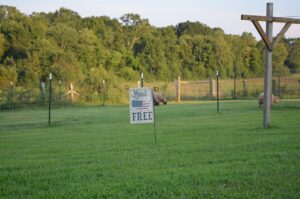
As an example, let’s say that the photos below are intended to represent the visual perspective of the shooting officer. The photographer is positioned in the location, and facing in the direction of the shooting officer, and the flag represents the subject presenting the threat.
The following photographs were taken at a distance of thirty (30) feet between the photographer and the flag. In each photograph, the photographer is stationary and the flag is stationary. Neither one moves nor changes for any of the photographs. The only thing changing between each photograph is the focal length setting on the camera lens.
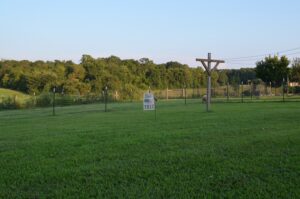
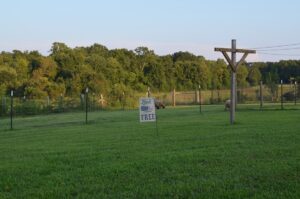
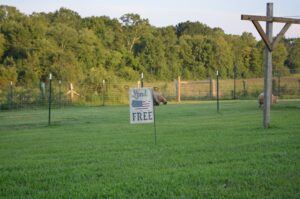

The focal length for each photograph is indicated under the photo. Note that the distance between photographer (officer) and flag (subject) appears vastly different in each photo, even though the distance between them never changes.
Accurate perspective photos require proper focal length settings.
The objective in taking visual perspective photos is to demonstrate as accurately as possible each person’s visual field from the distance in which it was observed. In the 24mm focal length photo, the subject appears to be very far away. In the 200 mm focal length photo, the subject appears to be immediately in front of the photographer. Neither one of these visual perspectives is accurate. The incorrect focal length setting on the camera lens creates an inaccurate representation of the person’s visual perspective. In order to accurately record a person’s visual perspective, the correct focal length must be used.
What is Focal length?
Focal length is the distance, measured in millimeters, between the surface of the image sensor (or film) and the optical center of the lens, where light rays converge.
Focal length is important to understand because it determines the lens’ field of view.
Shorter focal lengths such as a 24mm lens will provide a wide angle view.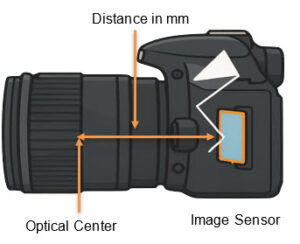
Longer focal lengths, such as a 200 mm lens, will provide a telephoto view.
Using a 24 mm focal length on a camera equipped with a full format image sensor will provide a field of view of approximately 84 degrees. This is considered a wide angle field of view and will incorporate more of the surrounding areas into the photograph. This field of view will also make the primary subject appear further away.
Using a 50 mm focal length on a camera equipped with a full format image sensor will provide a field of view of approximately 46 degrees. This is considered a “normal” or “natural” field of view and most closely represents what human eyes would “normally” or “naturally” see in the visual field when focused on a subject at the same distance. Although it may not be exact, it is generally accepted that this will provide the most accurate representation.
Know your Camera’s Image Sensor:
Many digital SLR cameras used by law enforcement are equipped with the APS-C image sensor rather than a full format image sensor. The APS-C image sensor is physically smaller than the full format image sensor and therefore will crop the image essentially giving it an effect similar to using a zoom lens. Therefore, a simple formula needs to be applied in order to determine the correct focal length for digital cameras equipped with APS-C (or other) image sensors.
A crop factor is basically the difference in size between the full format image sensor and the image sensor used by your agency’s camera.
The crop factor for the APS-C image sensor on Nikon cameras is 1.5. So, in order to calculate the correct focal length for a Nikon camera equipped with an APS-C image sensor, simply divide the 50mm focal length by 1.5. (50mm / 1.5 = 33.333 mm)
The crop factor for the APS-C image sensor on Canon cameras is 1.6. So, in order to calculate the correct focal length for a Canon camera equipped with an APS-C image sensor, simply divide the 50mm focal length by 1.6. (50mm / 1.6 = 31.25 mm)
As a general rule of thumb, the following focal lengths should be used when taking perspective photos:
50mm focal length for cameras with a full format image sensor.
33mm focal length for Nikon cameras with an APS-C image sensor
31mm focal length for Canon cameras with an APS-C image sensor
If your agency’s camera is equipped with an image sensor of a different size, it will be necessary to determine the crop factor for that particular image sensor to use in your calculation.
It is advisable to take measurements to demonstrate the distance between the person whose visual perspective is being documented and the subject in the photograph. This will help reconcile any questions as to accurate distances.

