by Stan B. Walters
ORCID 0009-0002-1063-0519
One of the long-standing warnings in interview and interrogation training is that no single behavior proves a person is lying. That warning is still correct. A subject’s posture, eye contact, movement, voice quality, response timing, facial expression, or visible discomfort should never be treated as proof of deception by itself. Human behavior is too variable, too context-dependent, and too vulnerable to misinterpretation for any single cue to carry that kind of weight.
The more difficult problem arises when the interviewer accepts that warning in theory, but then tries to solve the problem by simply adding more cues together. One behavior may be weak, but several behaviors are often treated as stronger. The collection is then described as a “cluster,” and the cluster begins to take on more meaning than the individual behaviors can support. That is where the analysis can start to drift.
A cluster only improves the quality of an assessment if the observations inside that cluster are themselves reliable, relevant, and properly interpreted. If the cues being collected are vague, unsupported, misread, or common to stress, confusion, fear, embarrassment, anger, trauma, fatigue, or pressure, then grouping them together does not make the conclusion stronger. It only organizes the error.
In practical terms, a cluster of weak cues is still weak. A cluster of unreliable cues is still unreliable. A cluster of stress behaviors is not automatically a deception cluster. The interviewer may feel more confident because several things appeared to happen at once, but confidence is not the same as accuracy. In fact, confidence can become especially dangerous when the foundation of the conclusion is behavioral overreach.
The Original Value and the Modern Risk of Cluster Thinking
The concept of behavioral clusters developed as a safeguard against over-reading single behaviors. In that sense, the original caution had value. Interviewers were being warned not to jump to conclusions based on one isolated movement or one visible reaction. A person who scratches their face, looks away, shifts in a chair, folds their arms, or pauses before answering has not thereby revealed deception.
The problem is that the safeguard can become the shortcut. Instead of preventing premature conclusions, cluster thinking can sometimes create a more sophisticated-sounding path to the same premature conclusion. The interviewer may no longer say, “He looked away, so he lied.” Instead, the interviewer may say, “He looked away, shifted posture, touched his face, and hesitated, so that cluster suggests deception.” The language sounds more analytical, but the underlying problem remains if those behaviors are not valid indicators of deception in the first place.
This distinction matters because many behaviors commonly taught or assumed to be deception indicators are also common stress reactions. They can appear in truthful people, deceptive people, anxious people, angry people, traumatized people, distracted people, and people who are simply trying to manage the pressure of being questioned. Without careful attention to context and statement content, the interviewer may mistake emotional or cognitive strain for evidence of lying.
The issue is not whether behavior should be ignored. Behavior can be useful. It can help an interviewer recognize discomfort, confusion, topic sensitivity, resistance, fear, or a need to slow down and clarify. The issue is whether the behavior is being used properly. Behavioral change should trigger professional curiosity. It should not substitute for evidence.
Stress Is Information, Not Proof of Deception
Stress is one of the most commonly misinterpreted features in the interview room. A subject may become visibly uncomfortable for reasons that have nothing to do with deception. A truthful person may become stressed because they fear they will not be believed. A witness may become stressed because the event was traumatic. A victim may become stressed because the topic is humiliating or painful. A suspect may become stressed because the consequences are serious, even if the specific statement being given is true.
The interview setting itself can create stress. The authority of the interviewer, the seriousness of the allegation, the uncertainty of the outcome, the presence of recording equipment, the subject’s prior experience with law enforcement, cultural factors, language issues, fatigue, embarrassment, and fear of collateral consequences can all affect behavior. None of those factors automatically establishes deception.
This is why stress must be separated from deception in the interviewer’s analysis. Stress tells the interviewer that something may be happening. It does not, by itself, explain what is happening. A stress reaction may mark a topic that needs additional exploration, but the meaning of that reaction must be developed through careful questioning, not assumed through cue counting.
When stress is mislabeled as deception, the interview can become contaminated. The interviewer may become more accusatory, less patient, and less willing to consider innocent explanations. The subject’s normal stress reaction may then intensify under pressure, which the interviewer may interpret as further evidence of deception. At that point, the interviewer is no longer merely observing behavior. The interviewer is helping create the behavior being interpreted.
That cycle is one of the major dangers of behavioral overconfidence. Once the interviewer decides that stress equals deception, every additional stress reaction can appear to confirm the original assumption. The result is not better analysis. It is confirmation bias in motion.
Cue Stacking and the Illusion of Reliability
Cue stacking occurs when the interviewer adds multiple weak observations together and treats the collection as if it has become reliable. This can happen even when the individual observations are nonspecific, ambiguous, or unsupported. A person looks away, shifts posture, answers slowly, rubs their face, and crosses their arms. The behaviors are counted, the count becomes a cluster, and the cluster is then given diagnostic weight.
The flaw is simple. More does not automatically mean better. If the underlying cues are not reliable indicators of deception, then adding more of them does not solve the reliability problem. A larger number of weak observations may produce a stronger impression, but it does not necessarily produce a stronger conclusion.
This is especially important in professional training environments. If investigators are taught that certain behaviors indicate deception, they may begin to see those behaviors everywhere. Once they are told to look for clusters, they may become even more confident because the behaviors appear together. The danger is that the training has not improved their accuracy. It has improved their ability to organize and defend a flawed assumption.
A cluster should never be treated as a shortcut around the need for facts, context, and statement testing. Behavioral observations may help guide inquiry, but they should not replace it. The interviewer’s task is not to count gestures. The interviewer’s task is to develop reliable information and test that information against reality.
Behavior Should Direct the Interview, Not Decide the Case
The proper use of behavior is directional, not diagnostic. A behavioral change may suggest that the interviewer should slow down, clarify a question, return to a topic, explore a contradiction, or ask for more detail. It may suggest that a subject is experiencing cognitive strain, emotional discomfort, or uncertainty. It may also suggest that the topic has significance. But significance is not the same as deception.
The interviewer should ask, “What was happening at the moment the behavior changed?” That question is far more useful than asking, “What does that behavior mean?” The behavior must be tied to the question, the topic, the subject’s answer, the surrounding circumstances, and the broader evidence in the case.
For example, a subject may show visible stress when discussing a particular time period. That reaction may be important. It may indicate concealment, but it may also indicate fear, shame, confusion, memory difficulty, or concern about someone else’s involvement. The behavior identifies an area that may need careful development. It does not answer the question for the interviewer.
This is where professional interviewing must remain disciplined. The interviewer should use the behavioral observation to improve the next question, not to jump to the final conclusion. The proper response is to explore the content, sequence, sensory detail, decision points, omissions, inconsistencies, and corroboration surrounding the subject’s account.
Behavior may point the interviewer toward a door. It does not tell the interviewer what is behind it.
Protecting the Statement From Interviewer Contamination
The central objective of an investigative interview is to obtain reliable information. That requires the interviewer to protect the statement from contamination. Contamination does not only come from leading questions or disclosed evidence. It can also come from the interviewer’s premature interpretation of the subject’s behavior.
Once the interviewer believes the subject is lying, the structure and tone of the interview can change. Questions may become more closed, more accusatory, more repetitive, or more confirmatory. The interviewer may interrupt more often, challenge too soon, or ignore details that do not fit the developing theory. The subject may then alter their behavior in response to the interviewer’s pressure, and that new behavior may be treated as additional evidence of deception.
In this way, a mistaken behavioral conclusion can shape the very statement the interviewer is supposed to be protecting. The subject’s account may become less complete, less spontaneous, and less reliable because the interviewer moved from information gathering to theory confirmation too early.
This is why the distinction between stress and deception is not merely academic. It has operational consequences. It affects the questions asked, the pressure applied, the information preserved, and the way the statement will later be examined by supervisors, prosecutors, defense counsel, judges, juries, and expert witnesses.
What happens in the interview room does not stay in the interview room. The reasoning behind the interviewer’s conclusions may eventually have to survive outside scrutiny.
A More Reliable Framework
A more reliable approach begins with restraint. The interviewer should recognize behavioral change without overclaiming its meaning. Stress should be documented as stress. Discomfort should be documented as discomfort. A pause should be documented as a pause. A shift in posture should be documented as a shift in posture. Those observations should not be converted into deception without additional support.
The next step is development. The interviewer should use behavioral changes to guide better questioning. When a subject’s behavior changes around a topic, the interviewer can explore the topic more carefully through open-ended prompts, clarification, sequencing, and requests for specific detail. The goal is to increase the quality of the statement, not merely increase pressure.
The final step is testing. The subject’s statement must be compared against known facts, independent evidence, timeline realities, physical evidence, digital records, witness accounts, and internal consistency. Reliable conclusions are built from tested information, not from behavior alone.
This approach does not require the interviewer to ignore behavior. It requires the interviewer to keep behavior in its proper place. Behavior may be a signal. It may be a prompt for further inquiry. It may help manage the room. But it should not become proof beyond what the behavior can actually support.
Conclusion
The warning that no single behavior proves deception remains essential. However, the modern caution must go further. A group of unreliable behaviors does not become reliable simply because the behaviors are grouped together. If the observations inside a cluster are vague, weak, unsupported, or better explained by stress, then the cluster does not solve the problem. It may simply disguise the problem.
Stress is not deception. Behavioral change is not proof. A cluster is not a conclusion.
The interviewer’s responsibility is to ask better questions, preserve the integrity of the statement, and test what was said against the realities of the case. Behavioral observations may help guide that process, but they should never replace it.
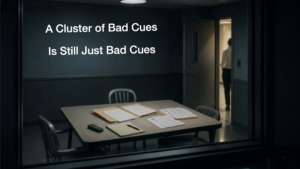
Sometimes a scratch is just a scratch. Sometimes stress is just stress. And sometimes a cluster of bad cues is still just bad cues.
© 2026 Stan B. Walters. All rights reserved. Brief excerpts may be quoted with attribution and a link to the original article. Reproduction, redistribution, or use in training materials requires written permission.
Author’s Note
Stan has addressed several proven “lie sign” myths in his Inside the Interview Room video series, including the dangers of relying on eye contact, eye movement, body language, and other behavioral shortcuts as indicators of deception. These episodes continue the larger discussion raised in this article: investigators should not be trained to treat behavior as proof. They should be trained to test the reliability of the subject’s account.